
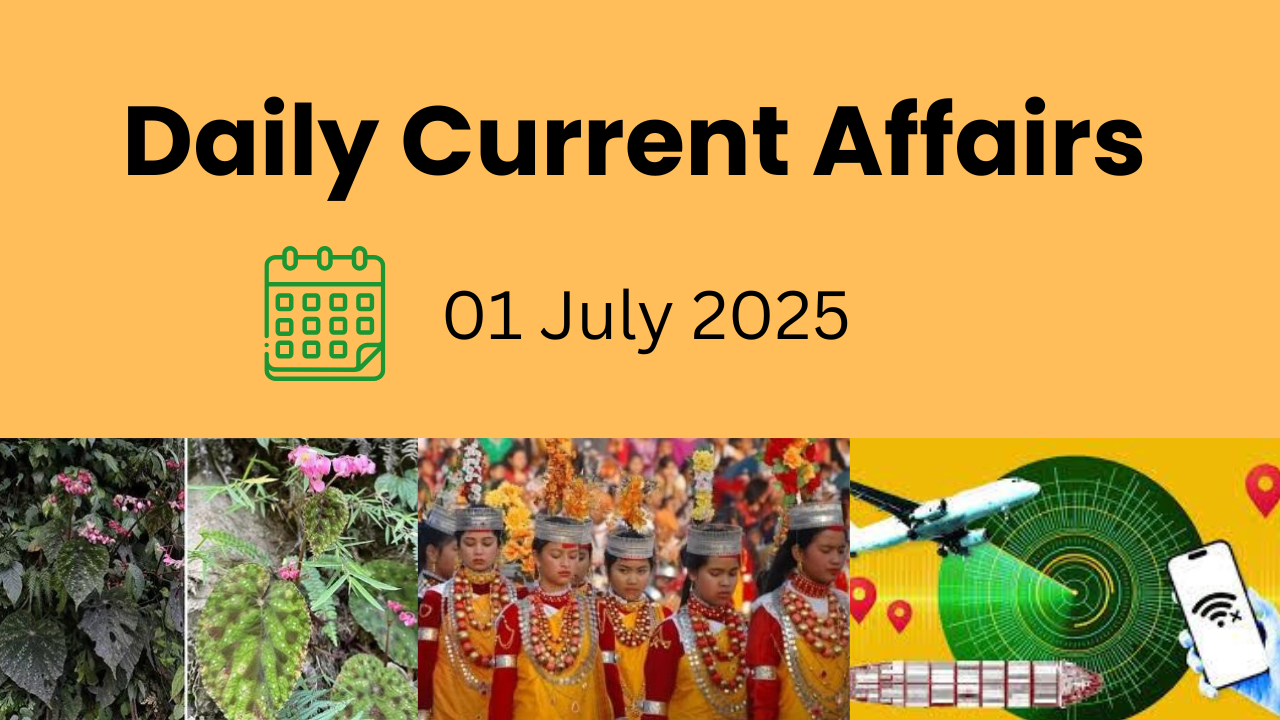
1. New Begonia Species Discovered in Arunachal Pradesh’s Eastern Highlands
Context: In a remarkable botanical breakthrough, forest officials in Arunachal Pradesh have discovered a new species of flowering plant, named Begonia nyishiorum, nestled deep within the lush, misty highlands of the East Kameng district. This stunning new species, found in only two forest sites, adds to India’s rich floral diversity and further emphasizes the ecological significance of the eastern Himalayas.

Key Highlights of Begonia nyishiorum:
- Endemic Location: This rare begonia is exclusive to the East Kameng district in Arunachal Pradesh, thriving on moist, shaded mountain slopes at elevations ranging from 1,500 to 3,000 metres above sea level.
- Unusual Appearance: It stands out with its dense crimson, fringed scales enveloping light green petioles—a distinctive indumentum never seen in any other Asian begonia to date.
- Taxonomic Significance: The fringed petiole is a unique morphological trait, setting it apart from over 2,150 known species of begonias around the world.
- Cultural Tribute: The species is named nyishiorum in honour of the Nyishi tribe, whose age-old sustainable practices and traditional forest stewardship have helped preserve the delicate ecosystems of this region.
- Conservation Status: As of now, Begonia nyishiorum is listed as Data Deficient under the IUCN Red List, highlighting the need for further research and conservation efforts.
Why This Discovery Matters:
The discovery of Begonia nyishiorum underlines the immense biodiversity of the Eastern Himalayas, one of the world’s biodiversity hotspots. Arunachal Pradesh alone houses over 500 species of orchids and more than 4,000 plant species, many of which remain undocumented or understudied.
Such findings serve as a reminder of the urgent need to protect fragile montane ecosystems, which face threats from climate change, deforestation, and unsustainable development.
Did You Know?
- The Begonia genus is among the largest genera of flowering plants, with new species still being described regularly—especially from tropical and subtropical regions.
- The Nyishi community, primarily found in central Arunachal Pradesh, practices jhum (shifting) cultivation, but also follows sacred forest traditions, which help conserve high-altitude biodiversity.
This discovery is not just a triumph for botany, but also a celebration of indigenous knowledge, ecological resilience, and the hidden treasures of India’s northeastern forests.
2. Similipal Tiger Reserve: A Biodiversity Jewel Amidst Tribal and Legal Tensions
Context: The Odisha High Court has recently issued a notice to the Integrated Tribal Development Agency (ITDA), Baripada, regarding a controversial ban that prevents the Munda tribal community of Jamunagarh village from performing traditional rituals at Jayara, a sacred site located within the Similipal Tiger Reserve. The move raises questions about the delicate balance between tribal rights and conservation policies in protected forest regions.

About Similipal Tiger Reserve:
Nestled in the Mayurbhanj district of northern Odisha, Similipal Tiger Reserve is a vast and ecologically rich landscape that forms part of the Deccan Peninsular Biogeographic Zone. Spanning an impressive 2,750 square kilometres, it blends the biological characteristics of the Eastern Ghats, Western Ghats, and the eastern Himalayas, making it a unique ecological corridor.
Geography and Terrain:
- The reserve lies within the Mayurbhanj Elephant Reserve, which also encompasses the Hadgarh and Kuldiha Wildlife Sanctuaries.
- Surrounded by rolling plateaus and high hills, its most prominent elevations are the twin peaks of Khairiburu and Meghashini, rising to 1,515 metres above sea level.
- The region features a mixed landscape of undulating hills, grassy meadows, and dense woodlands.
- Beautiful waterfalls such as Joranda and Barehipani enhance the natural charm of the reserve.
Rivers and Drainage:
- At least twelve rivers originate or flow through the park, eventually draining into the Bay of Bengal.
- Major rivers include Burhabalanga, Palpala Bandan, Salandi, Kahairi, and Deo.
Flora: A Botanical Bridge Between Regions
- Similipal’s vegetation consists primarily of Northern Tropical Moist Deciduous Forests, interspersed with semi-evergreen patches.
- The dominant tree is Sal (Shorea robusta), forming the backbone of the forest canopy.
- The flora also includes many medicinal and aromatic plants, crucial for both local livelihoods and pharmaceutical use.
- Botanically, the region represents a link between South Indian flora and Northeast Sub-Himalayan species, underscoring its biogeographic importance.
Fauna: Odisha’s Wild Heart
- Similipal is best known for being home to Odisha’s largest population of tigers, alongside Asiatic elephants and the hill mynah, a bird known for its mimicry.
- Other notable mammals include the leopard, sambar deer, barking deer, gaur (Indian bison), jungle cat, wild boar, four-horned antelope, giant squirrel, and common langur.
- The park also supports a rich diversity of birdlife, reptiles, and insects, making it a hub for biodiversity researchers and conservationists.
Historical and Conservation Milestones:
- Declared a Tiger Reserve in 1956, Similipal was later brought under Project Tiger in 1973, a flagship initiative of India for the protection of big cats.
- In 2009, Similipal earned global recognition when UNESCO designated it a part of the World Network of Biosphere Reserves.
Home to Indigenous Tribes:
Similipal is also the ancestral home to several indigenous tribal communities, including the Kolha, Santhala, Bhumija, Bhatudi, Gonda, Khadia, Mankadia, and Sahara. These communities maintain deep cultural and spiritual connections with the forests, depending on them for both livelihoods and rituals.
The recent legal development concerning the Munda tribe’s access to Jayara is a stark reminder that conservation must go hand-in-hand with tribal rights, heritage, and cultural autonomy.
Interesting Fact:
Similipal derives its name from the abundance of red silk cotton trees (Salmalia malabarica), locally known as “Simul”, which bloom spectacularly in spring, painting the forest canopy in vivid hues.
As one of India’s most picturesque and ecologically vital landscapes, Similipal Tiger Reserve remains a focal point for wildlife conservation, tribal rights, and environmental harmony. However, maintaining this balance requires sensitive, inclusive policies that honour both nature and people who call it home.
3. Khasi People: Guardians of a Matrilineal Heritage Amidst Legal Uncertainty
Context: In recent developments, the Meghalaya High Court has admitted a Public Interest Litigation (PIL) that could significantly affect the issuance of Scheduled Tribe (ST) certificates to members of the Khasi tribe. The PIL challenges a recent government decision that has effectively stalled the processing of hundreds of tribal applications, raising concerns about identity, rights, and future access to constitutional protections for many in the Khasi community.

Who Are the Khasi People?
The Khasi are one of the oldest indigenous communities in northeast India, predominantly residing in the Khasi and Jaintia Hills of Meghalaya. Smaller populations also exist in parts of Assam and Bangladesh. Scholars believe the Khasis migrated from Tibet or Burma around 500 B.C., making them one of the earliest known settlers in the region.
Language and Identity:
The Khasi people speak the Khasi language, a member of the Austroasiatic language family, which links them linguistically to communities as far away as Vietnam and Cambodia. While English and Hindi are commonly spoken, Khasi remains their primary language, reflecting a deep cultural pride and continuity.
A Matrilineal Society: Power Through the Mother’s Line
One of the most fascinating aspects of Khasi culture is their matrilineal system, where inheritance, family lineage, and clan names are passed down through women. In Khasi society:
- Women are the custodians of property and tradition.
- The youngest daughter, known as the Ka Khadduh, inherits ancestral property.
- Men still participate in public affairs and religious rituals, but women wield significant authority in household and community life.
This rare social structure has sparked global academic interest and is considered a living example of gender-balanced traditions.
Religion and Spiritual Life:
While the majority of Khasis have embraced Christianity, especially Presbyterianism, elements of their indigenous beliefs still persist. There are also small groups of Khasi Hindus and Muslims. Many continue to revere U Blei Nongthaw (the Creator) in various cultural and seasonal rituals.
Livelihood and Modern Aspirations:
Traditionally reliant on agriculture, especially shifting cultivation, today’s Khasi youth are excelling in a variety of fields such as:
- Medicine
- Engineering
- Entrepreneurship
- Education
- Government Services
This shift illustrates how the community blends modern ambition with cultural preservation.
Legal Recognition and Rights:
The Khasi people are constitutionally acknowledged as a Scheduled Tribe (ST) in India, affording them several benefits:
- Customary laws are protected under the Indian Constitution.
- They enjoy land ownership rights within their community territories.
- They benefit from reservations in education and employment.
- The Khasi Hills Autonomous District Council (KHADC) safeguards their traditional governance structures and unique cultural practices.
Festivals: A Colorful Celebration of Nature and Heritage
The Khasis celebrate life, nature, and community through various vibrant festivals:
- Shad Suk Mynsiem – A spring festival symbolizing thanksgiving, fertility, and nature’s blessings, where dancers in traditional attire perform in rhythmic harmony.
- Nongkrem Dance Festival – A five-day sacred event praying for a bountiful harvest and communal well-being.
- Behdienkhlam – A rain-centric ritual aimed at driving away evil spirits and inviting good health and fortune.
Their musical traditions use indigenous instruments such as the Duitara (a plucked string instrument) and the Tangmuri (a traditional wind instrument), enriching these celebrations with rhythmic grace.
Nature’s Architects: The Living Root Bridges
A testament to Khasi ingenuity and environmental harmony, Living Root Bridges are marvels of bioengineering. Created by guiding the aerial roots of the Ficus elastica tree, these bridges:
- Can span over 100 feet.
- Are centuries old, durable, and sustainable.
- Require 20–30 years to become functional and only grow stronger with time.
The most iconic of these, the “Double-Decker Root Bridge” in Nongriat village, has become a symbol of eco-tourism and sustainable living.
Conclusion: A Living Culture Bridging the Ancient and the Modern
The Khasi people are not just a tribe—they are a living narrative of resilience, sustainability, and deep-rooted cultural wisdom. As they navigate modern legal challenges and societal transitions, their matrilineal values, ecological intelligence, and vibrant traditions continue to inspire both admiration and academic study.
4. India Tightens Jute Import Norms from Bangladesh Over Trade Imbalance and Strategic Tensions
Context: In a significant policy shift, the Government of India has imposed strict restrictions on the import of jute products and woven fabrics from Bangladesh, permitting their entry only through the Nhava Sheva seaport in Maharashtra. This latest move—announced via a notification by the Directorate General of Foreign Trade (DGFT) in June 2025—marks a major recalibration of India’s trade strategy in response to both economic and strategic concerns.

Land Route Imports Blocked Amid Strategic Warnings:
The new directive blocks the import of all jute-related goods via land ports, excluding only consignments transiting to Nepal and Bhutan. The curbs are widely seen as a response to:
- Bangladesh’s growing alignment with China, which has raised red flags in New Delhi
- Ongoing trade violations, including evasion of anti-dumping duties (ADD)
- Adverse impact on India’s jute industry, especially in West Bengal, Bihar, Odisha, and Assam
What Products Are Affected?
The restrictions cover a broad range of jute goods, including:
- Raw and processed jute fibres
- Flax tow and jute waste
- Single and multiple yarns made from jute or flax
- Unbleached and woven jute fabrics
These items, previously imported duty-free under the SAFTA Agreement, will now face stricter entry rules and customs oversight.
How Bangladeshi Subsidies Hurt Indian Producers:
Despite India having already levied anti-dumping duties, Bangladeshi exporters have reportedly bypassed regulations using various tactics such as:
- False declarations and under-invoicing
- Overstated production capacities
- Technical exemptions and third-country routing
The result: jute imports from Bangladesh surged from USD 117 million in FY 2021–22 to USD 144 million in FY 2023–24, eroding market share for Indian producers.
Jute Crisis at Home: Farmers and Mills in Distress
- In FY 2024–25, jute prices in India plummeted below 5,000 per quintal, far less than the Minimum Support Price (MSP) of 5,335, leading to distress among farmers.
- Six jute mills have shut down, with over 1,400 crore in unpaid dues, including legacy liabilities.
- The sector, which employs over 4 lakh workers, faces a severe liquidity crunch and under-utilisation due to cheap Bangladeshi imports flooding the market.
Policy Objectives Behind India’s New Import Strategy:
India’s decision to restrict imports to a single maritime entry point (Nhava Sheva) is designed to:
- Enforce stringent quality checks (including for hydrocarbon oil-free fabrics)
- Prevent fraudulent labelling and false origin claims
- Disrupt illegal transshipment routes via third countries
- Send a clear geopolitical signal to Bangladesh amid its growing proximity to China
While Bangladesh has responded with limited diplomatic accommodations, it continues to offer export incentives on value-added jute products, worsening the trade deficit.
Reviving India’s Jute Economy: What Lies Ahead
- Indian authorities are considering expanding protection mechanisms to include raw jute, which currently falls outside the scope of anti-dumping duties.
- More robust import surveillance, policy reforms, and tariff recalibration are expected to stabilise the market.
- Emphasis is likely to grow on reviving domestic jute processing, encouraging modernisation of mills, and supporting sustainable farming practices to make the sector globally competitive.
Did You Know?
India is the largest producer of raw jute in the world, yet a significant portion of processed jute products is imported, mainly from Bangladesh. Jute—often called the “golden fibre”—is biodegradable, sustainable, and increasingly in demand globally due to the ban on single-use plastics.
This assertive trade policy reflects India’s dual focus: safeguarding domestic livelihoods while asserting regional strategic priorities. As global interest in eco-friendly fibres grows, revitalising the jute sector may hold the key to India’s green economy aspirations.
5. Rising GPS Interference Threatens Global Air and Sea Navigation
Context: Recent incidents—such as a Delhi–Jammu flight returning mid-route, a tanker collision in the Strait of Hormuz, and a cargo ship grounding near Jeddah—have drawn global attention to the growing menace of GPS interference, now considered a critical threat to navigation and transport infrastructure.

What is GPS Interference?
GPS interference involves the deliberate or accidental disruption of Global Positioning System signals, which are vital for navigation across aviation, maritime, and ground transport sectors. These disruptions compromise the ability of aircraft, ships, and vehicles to accurately determine their position, timing, and direction, increasing the risk of accidents, disorientation, and delays.
Two Major Types of Interference
GPS Jamming:
- Uses high-powered radio transmitters to overwhelm GPS signals.
- Causes the receiver to lose location and time data.
- Commonly used in electronic warfare and criminal activities.
GPS Spoofing:
- Sends false GPS signals that mimic real satellite transmissions.
- Tricks the receiver into accepting wrong coordinates or time.
- More dangerous than jamming because it manipulates rather than blocks.
Both forms are now being weaponised in conflict zones and pose severe risks to civilian aviation and commercial shipping.
Aviation Risks on the Rise:
- Inaccurate GPS signals can mislead pilots about aircraft position, causing risks such as terrain collisions or mid-air confusion.
- Instrument Landing Systems (ILS) remain reliable during spoofing, but en route navigation remains vulnerable.
- The DGCA has made crew training mandatory for recognising and responding to GPS anomalies.
- Backup systems like Inertial Navigation Systems (INS) and VOR/DME are now critical for air safety.
Maritime Navigation Under Threat:
- Spoofed GPS data has led to ships straying off-course, grounding, or entering restricted waters.
- Many vessels now switch to manual control and rely on traditional methods like:
- Terrestrial navigation using lighthouses and radars
- Paper charts and manual plotting
- Ships are adopting multi-constellation navigation, combining:
- GPS (USA)
- GLONASS (Russia)
- Galileo (EU)
- BeiDou (China)
This GNSS diversification enhances resilience by reducing dependence on any one system.
Global Hotspots for GPS Interference
Red Sea & Persian Gulf:
- A 350% increase in spoofing incidents recorded in Q1 2025.
- Some vessels reported location jumps of hundreds of nautical miles.
- Tensions in the region have made shipping lanes increasingly hazardous.
Eastern Europe:
- Ongoing Russia–Ukraine conflict has turned Eastern European airspace into a spoofing hotspot, affecting commercial and civilian aircraft.
Implications for Critical Infrastructure:
- Air traffic control systems, port operations, and vessel tracking platforms are deeply reliant on GPS.
- Interference can cause systemic failure, delays, and safety breaches at national and international levels.
- Civilian infrastructure, though not the intended target, often suffers collateral disruption from military-grade jamming and spoofing.
How the World is Responding:
For Aircraft:
- Inertial navigation, radio beacons, and ILS are being upgraded.
- Dead reckoning and celestial navigation, though old-fashioned, are being revisited for emergencies.
- Pilot training programs now include simulations of spoofing/jamming events.
For Ships:
- Greater reliance on manual operations during spoofing incidents.
- Investments in robust radar systems, autonomous fail-safes, and paper-based chart backups.
- Hybrid GNSS receivers capable of cross-verifying satellite data across constellations.
India’s Strategic Preparedness:
India is enhancing resilience through NavIC, its indigenous navigation system developed by ISRO. Designed for both military and civilian use, NavIC provides accurate positioning over India and surrounding regions and serves as a backup during global GPS disruptions.
Did You Know?
- GPS signals travel from satellites over 20,000 km away, making them extremely weak and vulnerable when they reach Earth—comparable to a 30-watt bulb viewed from space.
- Spoofing devices can be portable and cost just a few hundred dollars, making them attractive for rogue actors and criminal networks.
The Way Forward: Layered Navigation Security
Ensuring safe and reliable navigation demands a multi-pronged approach:
- Redundancy in aircraft and ship systems
- National autonomy through indigenous satellite networks
- International coordination to track, trace, and counter interference zones
- Regulations and sanctions against spoofing sources and offenders
In an age where digital navigation underpins global logistics, GPS interference is more than a technical problem—it’s a strategic vulnerability that demands urgent global action.
6. Madagascar: A Strategic Island Nation with Deep Ties to India
Context: In a significant gesture of diplomatic goodwill, India’s Minister of State for Defence represented the nation at the 65th Independence Day celebrations of Madagascar, reinforcing the growing bilateral ties between the two countries. This high-level representation signals India’s continued commitment to strengthening relations with African nations, especially those with strategic maritime importance.

Strategic Location in the Indian Ocean:
Madagascar, located 250 miles off the southeastern coast of Africa, is a key player in the Indian Ocean Region (IOR). It shares maritime boundaries with several important territories and nations, including Comoros, Mozambique, Mauritius, Seychelles, and French overseas territories like Mayotte and Réunion. Its location gives it substantial geostrategic relevance for maritime trade, regional security, and climate interactions.
Geographical Significance: The World’s Fourth Largest Island
- As the fourth largest island on the planet, Madagascar boasts a rich ecological heritage. It is home to nearly 5% of the world’s biodiversity, with an astonishing 80% of its flora and fauna found nowhere else on Earth. This makes it a hotspot for ecotourism, conservation efforts, and scientific research.
Madagascar and the Indian Monsoon: A Climate Connection
Madagascar plays a critical role in shaping the Indian monsoon system. The Mascarene High, a high-pressure system located near Madagascar, helps initiate the southwest monsoon that brings rainfall to the Indian subcontinent.
- The moisture-laden southeasterly winds, originating from the Mascarene High, begin their journey near Madagascar and travel toward Somalia.
- After crossing the equator, the Coriolis effect deflects them, turning them into southwesterly winds that sweep across the Indian Peninsula, bringing crucial seasonal rains.
- The monsoon cycle retreats through the Tibetan Plateau, eventually dissipating over Madagascar, completing a natural climatic loop that spans continents.
Why Madagascar Matters to India:
- Strategic Maritime Link: Key to India’s SAGAR (Security and Growth for All in the Region) vision.
- Ecological Treasure: A vital region for climate studies and biodiversity conservation.
- Diplomatic Partner: Enhancing ties with Indian Ocean nations supports India’s Indo-Pacific strategy.
Did You Know?
Madagascar is sometimes referred to as the “Eighth Continent” due to its distinctive and isolated evolutionary history.
It separated from the Indian subcontinent about 88 million years ago, allowing species to evolve in isolation.
The island has a mixed cultural heritage, influenced by African, Arab, Indian, and French settlers.
Madagascar is not just an island—it is a geopolitical, ecological, and climatic cornerstone in the Indian Ocean. India’s growing engagement with Madagascar reflects its larger vision of regional cooperation, environmental stewardship, and strategic diplomacy.


